Adaptive Responsive Teaching: The Equity Strategy That Closes the Disadvantage Gap

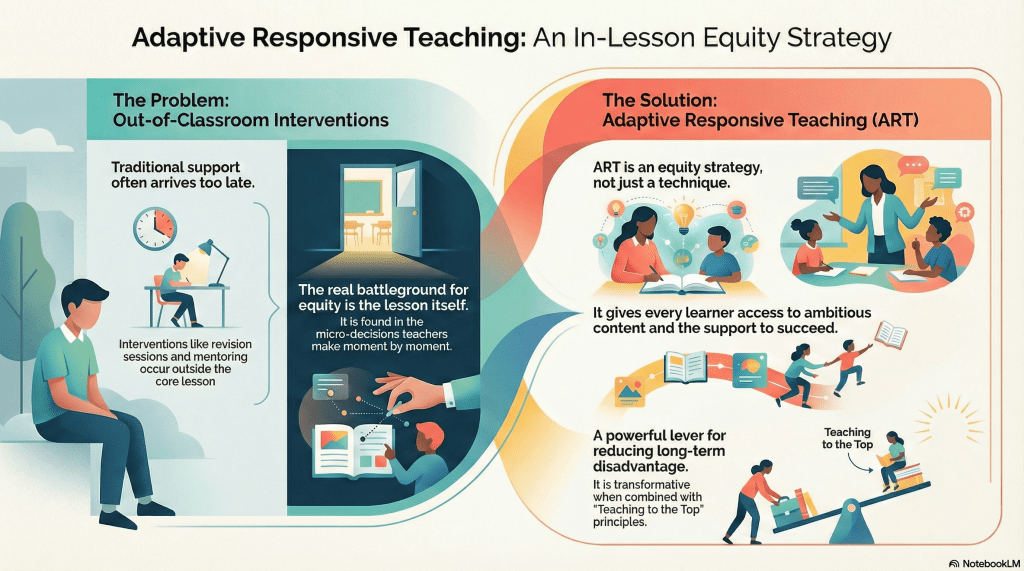
For years, schools have tried to close the disadvantage gap through interventions outside the classroom—revision sessions, mentoring programmes, and targeted catch‑up. While these can help, they often arrive too late. The real battleground for equity is not after school or after the assessment cycle. It is during the lesson itself, in the micro‑decisions teachers make as they respond to what learners do and do not yet understand.

This is where Adaptive Responsive Teaching (ART) becomes transformative. It is not simply a pedagogical technique. It is an equity strategy—one that ensures every learner, regardless of background, is given access to ambitious curriculum content and the support needed to succeed with it.

When combined with the principles of Teaching to the Top, ART becomes one of the most powerful levers schools have for reducing long‑term disadvantage.
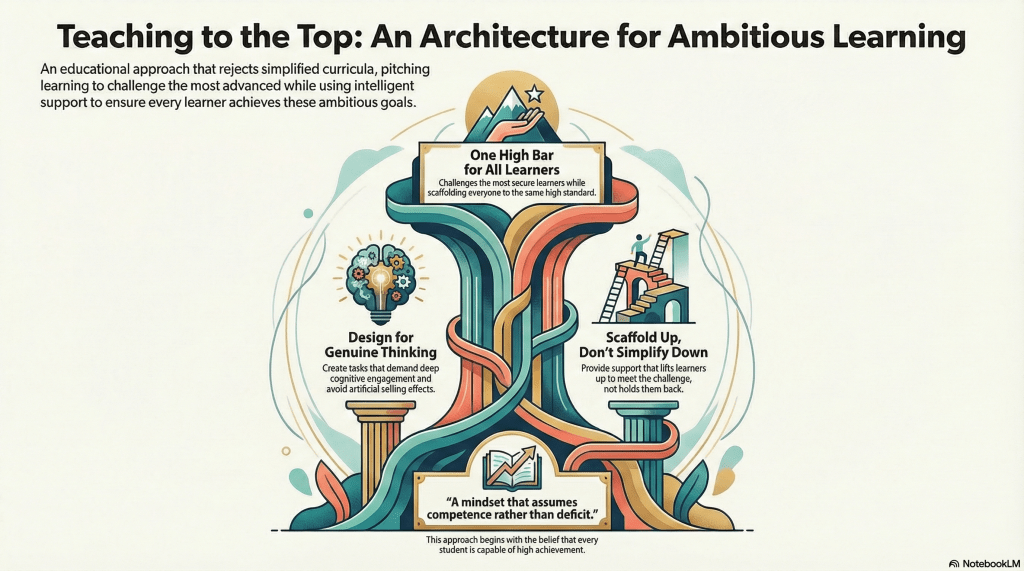
Teaching to the Top: The Mindset Behind Real Challenge

Teaching to the Top is built on a simple but uncompromising belief:
Every learner deserves access to high challenge and powerful knowledge.

This approach rejects the idea that some students need a “lower” version of the curriculum. Instead, it insists that teachers set learning at a level that challenges even the most secure learners, while using intelligent scaffolding to ensure everyone reaches the same destination.

Teaching to the Top is not about making students work harder for the sake of it. It is about:

  • Setting ambitious goals
  • Designing tasks that require genuine thinking
  • Avoiding ceiling effects
  • Using scaffolds that lift learners up, not hold them down

It is a mindset that assumes competence rather than deficit. And it aligns perfectly with Adaptive Responsive Teaching.
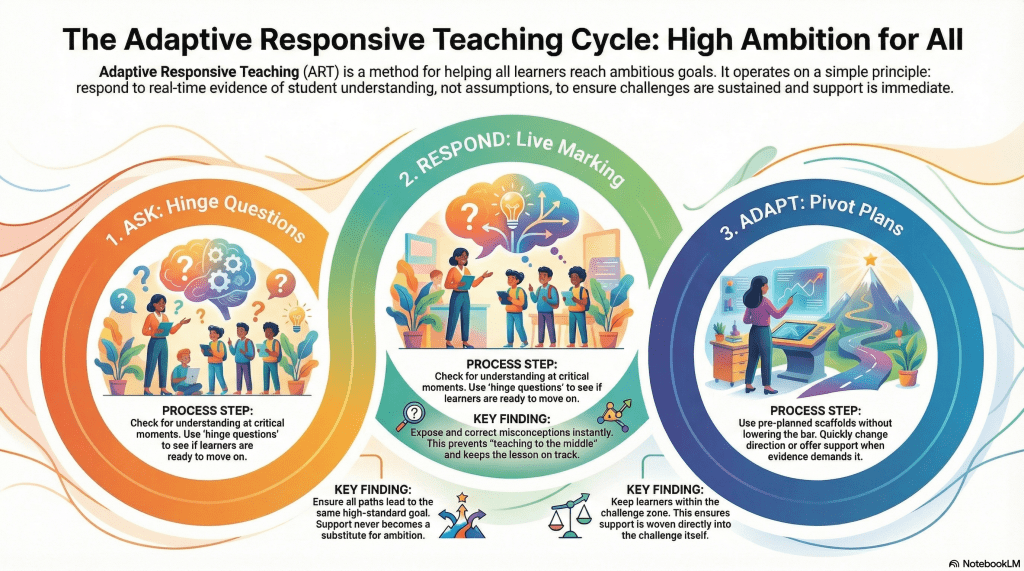
Adaptive Responsive Teaching: The Method That Makes Ambition Possible

If Teaching to the Top sets the ambition, Adaptive Responsive Teaching provides the mechanism for ensuring all learners reach it.

ART is built on a simple principle:
Respond to real‑time evidence, not assumptions.

Instead of waiting until after the lesson to discover who struggled, ART ensures that misconceptions are caught early, support is immediate, and challenge is sustained.

Three practices make this possible:

1. Hinge Questions: Precision in the Moment

Hinge questions are the pulse checks that reveal whether learners are ready to move on. They expose misconceptions at the exact moment they matter most.

In a Teaching to the Top classroom, hinge questions:

  • Prevent “teaching to the middle”
  • Signal when to deepen the challenge
  • Identify who needs scaffolding—not simplification
  • Ensure no learner is left behind as the lesson progresses

They turn assessment into a live tool for equity.

2. Live Marking: Feedback That Keeps Challenge Alive

Live marking shifts feedback from retrospective to immediate. Instead of discovering errors after the lesson, teachers address them in the moment.

This matters for equity because:

  • Misconceptions are corrected before they become entrenched
  • Learners stay within the challenge zone
  • Teachers can adjust explanations, models, or scaffolds instantly

Live marking ensures that the challenge is not diluted simply because some learners need more support. Instead, support is woven into the challenge.

3. Pivot Plans: Scaffolding Without Lowering the Bar

Pivot plans are pre‑planned adaptations that allow teachers to change direction quickly when evidence demands it. They ensure that scaffolding is purposeful, temporary, and aligned with the high‑challenge goal.

Pivot plans prevent the common equity pitfall of accidental ceiling‑setting. They guarantee that:

  • Every learner works towards the same high‑standard outcome
  • Alternative routes still lead to the same destination
  • Support never becomes a substitute for ambition

This is Teaching to the Top in action.
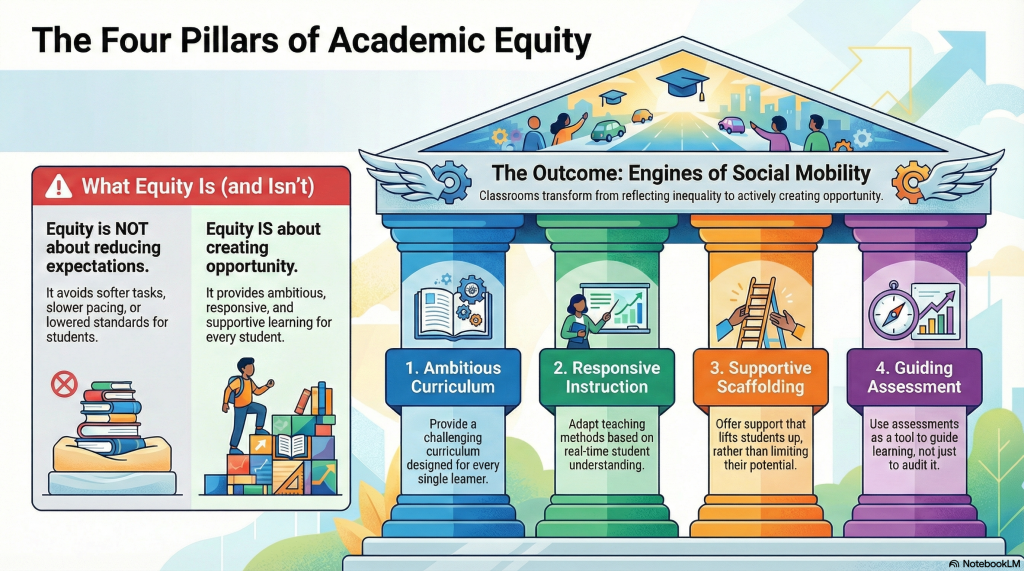
What Equity Looks Like in Practice

Equity is not about softer tasks, slower pacing, or reduced expectations.
Equity is:

  • Ambitious curriculum for every learner
  • Responsive instruction that adapts to real‑time understanding
  • Scaffolding that lifts, rather than limits
  • Assessment that guides learning, not audits it

When Teaching to the Top and ART work together, classrooms become engines of social mobility rather than mirrors of existing inequality.
The Micro-Decisions That Close the Gap

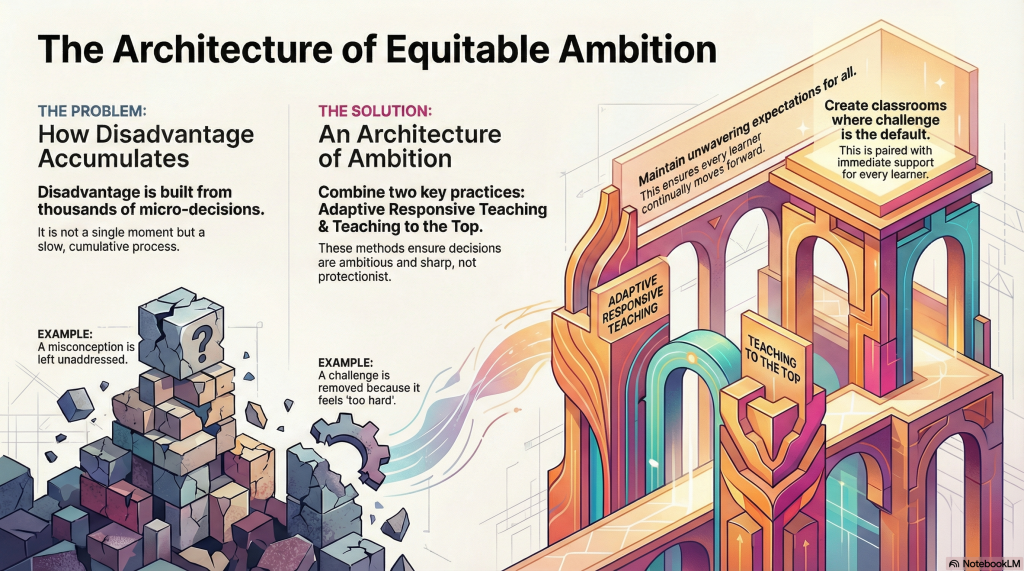
Long‑term disadvantage does not emerge from a single moment. It accumulates through thousands of micro‑decisions:

  • A misconception left unaddressed
  • A scaffold left in place too long
  • A challenge was removed because it felt “too hard”
  • A learner quietly opting out of thinking

Adaptive Responsive Teaching sharpens these decisions.
Teaching to the Top ensures they are rooted in ambition, not protectionism.

Together, they create classrooms where:

  • Challenge is the default
  • Support is immediate
  • Expectations are unwavering
  • Every learner moves forward

This is what equity looks like when it is lived, not just stated.
Making Every Moment Count

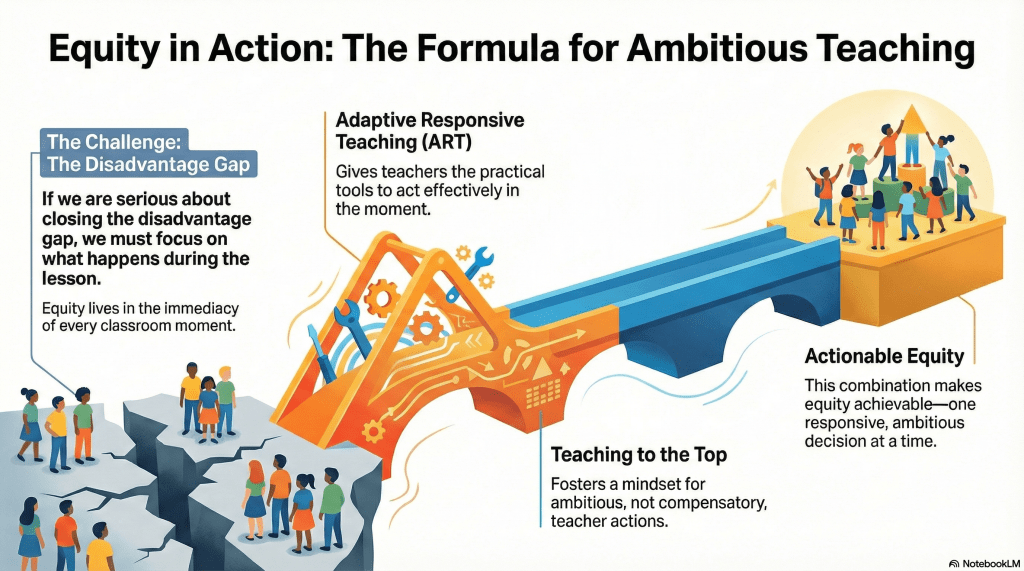
If we are serious about closing the disadvantage gap, we must focus on what happens during the lesson. Adaptive Responsive Teaching gives teachers the tools to act in the moment. Teaching to the Top gives them the mindset to ensure those actions are ambitious, not compensatory.

Equity lives in the immediacy of the classroom.
ART and Teaching to the Top make that equity visible, actionable, and achievable—one responsive, ambitious decision at a time.
The Adaptive Responsive Teaching Compass: A Blueprint for Equitable, High‑Impact Classrooms

Introduction

In classrooms where learners bring diverse starting points, needs, and barriers, teaching cannot rely on a fixed script. Learning is rarely linear, and students don’t all follow the same route to understanding. Adaptive Responsive Teaching offers a way to navigate this complexity with precision and purpose.

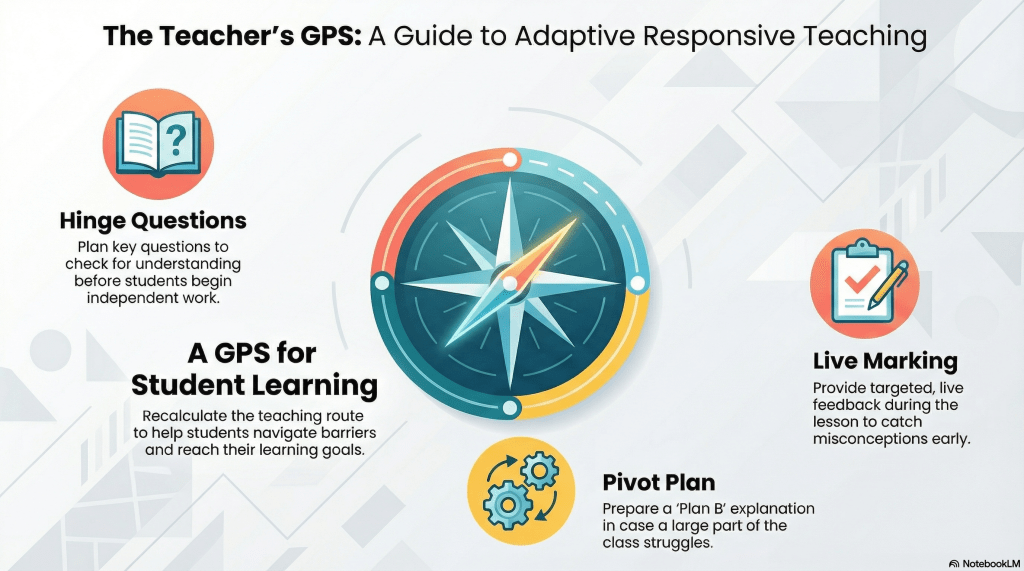
It functions much like a GPS for a student’s learning journey. Rather than following a rigid map, the teacher continually recalculates the route based on the roadblocks a student encounters—particularly SEND‑related barriers. The destination remains the same for everyone: high academic standards. But the path becomes more accessible, more responsive, and more attuned to the learner’s needs. This ensures that every student, regardless of their starting point, can reach the summit through a route that works for them.

This philosophy underpins the entire Adaptive Responsive Teaching model: a system built on real‑time evidence, flexible instructional pivots, and an unwavering commitment to equity.

What Is Adaptive Responsive Teaching?

Adaptive Responsive Teaching is built on the principle that instructional decisions should be shaped by what students actually understand—not what we assume they understand. This aligns strongly with the Education Endowment Foundation (EEF), which emphasises diagnostic assessment, responsive instruction, and high‑quality feedback as core drivers of pupil progress.

Teachers gather real‑time evidence through three core practices:

1. Hinge Questions

Hinge questions reveal whether students have grasped the core concept before moving on. They expose misconceptions and guide the teacher’s next move.

The EEF’s Teacher Feedback guidance states that feedback is most effective when it is timely, specific, and actionable. Hinge questions provide exactly this.

The EEF’s SEND in Mainstream Schools guidance highlights that pupils with SEND benefit from frequent, low‑stakes checks for understanding, which reduce cognitive load and prevent misconceptions from accumulating.

Doug Lemov’s Check for Understanding mirrors this approach, insisting on frequent, high‑quality data to inform instructional decisions.

2. Live Marking

Live marking provides immediate, individualised feedback during the lesson. It prevents misconceptions from becoming entrenched and supports rapid correction.

The EEF emphasises that in‑lesson feedback is often more impactful than written comments delivered later.

Pupils with SEND benefit from immediate, precise feedback, as delayed feedback increases the risk of misconceptions becoming embedded.

This aligns with Lemov’s Show Call and Right is Right, in which student work serves as a live teaching tool and feedback is academically rigorous.

3. Pivot Plans

A Pivot Plan is a pre‑prepared alternative explanation or model that can be deployed instantly if a significant proportion of the class has not grasped a concept.

The EEF’s Implementation guidance stresses the importance of anticipating barriers and planning for likely misconceptions.

The EEF notes that pupils with SEND often require multiple representations, alternative explanations, and structured scaffolds. Pivot Plans ensure these supports are intentionally designed in advance.

This mirrors Lemov’s Double Plan, where teachers plan both teacher actions and student actions in parallel.

How Adaptive Responsive Teaching Drives Equitability

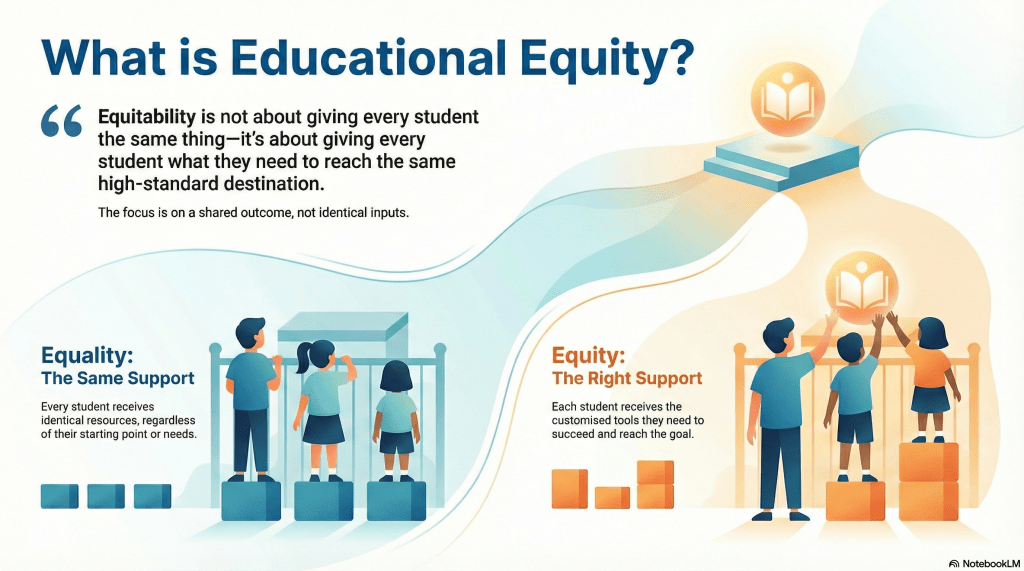
Equitability is not about giving every student the same thing—it’s about giving every student what they need to reach the same high‑standard destination.

The Adaptive Responsive Teaching Compass supports this across three domains.

1. Equitability in the Classroom

Adaptive Responsive Teaching ensures that no student is left behind during the lesson.

  • Live marking enables immediate intervention.
  • Pivot Plans ensure the whole class moves forward together.
  • Real‑time feedback loops prevent small misunderstandings from becoming long‑term gaps.

The EEF identifies adaptive teaching, scaffolding, and explicit instruction as the most effective strategies for supporting SEND learners. Adaptive Responsive Teaching operationalises all three.

This echoes Lemov’s No Opt Out and Cold Call, ensuring every student participates and receives the support needed to succeed.

2. Equitability in the Curriculum

High expectations remain the anchor point.

SEND barriers are treated as roadblocks, not reasons to lower the destination. The curriculum stays ambitious, but the route becomes flexible.

The EEF stresses that high‑quality teaching is the most important lever for improving outcomes for pupils with SEND. The SEND Code of Practice reinforces that pupils with SEND should access a broad, balanced, ambitious curriculum.

This aligns with Lemov’s Stretch It and Format Matters, which maintain academic rigour while supporting students to reach it.

3. Equitability in Assessment

Formative assessment becomes a proactive tool for success, not a post‑mortem of failure.

  • Hinge questions confirm readiness for independent practice.
  • Mini‑whiteboard checks provide a whole‑class snapshot within seconds.

The EEF highlights that pupils with SEND often require more frequent, smaller assessment points to prevent overload and ensure misconceptions are caught early.

This aligns with Lemov’s Exit Tickets and Check for Understanding.

A Helpful Analogy: The Mountain Guide

Imagine a teacher as a mountain guide leading a diverse group of hikers. The summit—the high‑standard learning goal—is the same for everyone. But the guide might:

  • Offer a walking stick to one hiker
  • Suggest a gentler path for another
  • Pause to re‑explain a tricky section

The goal isn’t to get some hikers to the top. It’s to get everyone there, together.

Adaptive Responsive Teaching embodies this philosophy.

Why This Matters

Adaptive Responsive Teaching provides a practical, evidence‑driven framework for making equity real. It empowers teachers to:

  • Maintain high expectations
  • Respond to learning as it happens
  • Remove barriers before they become entrenched
  • Ensure every student reaches the intended destination

This isn’t just good pedagogy—it’s a moral imperative.

Adaptive Responsive Teaching is the compass that points the way.

Research Links

EEF – Teacher Feedback to Improve Pupil Learning
https://educationendowmentfoundation.org.uk/education-evidence/guidance-reports/feedback

EEF – Special Educational Needs in Mainstream Schools
https://educationendowmentfoundation.org.uk/education-evidence/guidance-reports/send (

EEF – Assessment and Feedback Evidence
https://educationendowmentfoundation.org.uk/education-evidence/teaching-learning-toolkit/feedback

EEF – Putting Evidence to Work: A School’s Guide to Implementation
https://educationendowmentfoundation.org.uk/education-evidence/guidance-reports/implementation

Hinge Questions – Jamie Clark
https://newsletter.jamieleeclark.com/p/hinge-questions

Formative Assessment – Renshaw & Wiliam
https://portal.geography.org.uk/downloads/journals/TG_AUT_2015_RENSHAW.pdf

⚖️ The Ethical Maths Classroom: High Expectations, Oracy, and Equity

In too many classrooms, mathematics is viewed as a subject of fixed ability—a gatekeeper that sorts students into those who “get it” and those who don’t. This mindset is not only limiting, but it’s fundamentally untrue and unethical.

Imagine a maths classroom where every student is treated not as a learner, but as a mathematician. A place where high expectations aren’t a burden, but a badge of honour. This subtle shift in perspective is the key to unlocking profound mathematical growth for all students, ensuring a more ethical and equitable learning environment.

The Ethical Imperative of High Expectations

The decision to set high expectations for all students is fundamentally an ethical one. When teachers presume that some students (often those from marginalised groups) are incapable of rigorous mathematical thinking, they perpetuate systemic inequities. Treating every student as a mathematician, regardless of their background or prior performance, is an act of educational justice.

High Expectations as an Ethical Practice:

Combating Deficit Thinking: It actively rejects the notion that a student’s lack of prior success is due to inherent deficits. Instead, it places the responsibility on the instructional design to meet the students where they are and propel them forward.

Ensuring Access to Power: Mathematical literacy is a powerful tool for civic engagement and economic mobility. Offering every student challenging, meaningful maths grants them access to this power.

Promoting Intellectual Respect: Students are respected as intellectual contributors whose ideas are valued, debated, and built upon, rather than passive recipients of facts.

Oracy and Vocabulary: Tools for Equitable Participation

A true mathematician doesn’t work in silence; they articulate their thinking, justify their claims, and critique the reasoning of others. Oracy (the ability to express oneself fluently and grammatically in speech) and precise mathematical vocabulary are foundational to treating every student as a mathematician and to ensuring equity.

The achievement gap is chiefly a knowledge gap and a language gap.

It can be greatly ameliorated by knowledge-based schooling

Why Knowledge Matter – E. D. Hirsh, Jr

A child who has the relevant domain-specific background knowledge will understand the passage and get the right answer fast without conscious strategising. A child who does not have the enough information relevant knowledge will have to use special glosses in the test and consciously apply strategies; that child won’t finish the test and will get many answers wrong.

Why Knowledge Matter – E. D. Hirsh, Jr

Promote Mathematical Talk (Oracy for Equity)

Structured maths talk ensures that the class discussion isn’t dominated by a few voices, which is key to ethical teaching.

Structured Discourse: Use techniques like “Think-Pair-Share” or “Mathematical Socratic Seminars” to ensure every voice is heard and every student practices expressing complex ideas.

Equalising Participation: Utilising Accountable Talk Stems provides the linguistic scaffolds necessary for students who may be English Language Learners or who lack confidence in speaking:

“I respectfully disagree with [Name] because…”

“My strategy is efficient because…”

“Can you restate that using the term congruent?”

Valuing Non-Verbal Reasoning: Recognise and respect that some students’ mathematical understanding is best expressed through models, diagrams, or gestures. Always follow up, asking them to verbally connect their model to a concept.

2. Mastering Mathematical Vocabulary (Access and Clarity)

Precise language is the key to precise thought. High expectations demand that students use the correct mathematical terms—not just colloquialisms.

Vocabulary is Access: Explicitly teaching terms like coefficient, variable, perimeter, and trapezium demystifies the language of mathematics, which often acts as a barrier to understanding.

Bridging Everyday and Academic Language: Help students transition from common words to their mathematical counterparts (e.g., from “the distance around” to perimeter; from “steepness” to gradient or slope).

Interactive Glossaries: Ensure key terms are visible and accessible. These tools provide a low-stakes reference point, reducing the anxiety associated with using technical language incorrectly.

Unlocking Potential: Why Retrieval Practice is a Game-Changer for SEND Students in Maths

In our ongoing mission to make maths accessible and achievable for every student, the formula for progress remains clear:

Consistency + Quality First Teaching + Culture = Progress.

While these elements benefit all learners, for students with Special Educational Needs and Disabilities (SEND), finding the right strategies is even more critical. One of the most powerful, evidence-backed tools in our arsenal is retrieval practice.

This isn’t just another starter activity; it’s a strategic approach rooted in cognitive science that can be transformative for students with SEND.

The Challenge: Overcoming the Cognitive Load

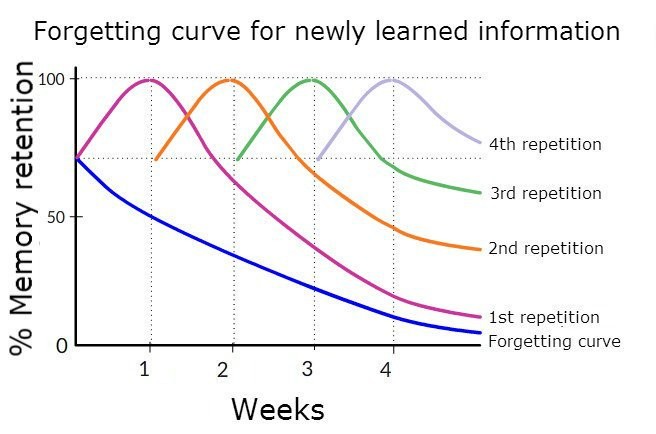
For students with SEND, the “Forgetting Curve” can represent a particularly steep hill to climb. This concept, developed by Hermann Ebbinghaus, describes how memory retention declines over time. While this is a universal human trait, the rate of forgetting can be more pronounced for individuals with SEND due to factors like differences in cognitive processing and memory capacity. For some students, this may result in a faster decline in retention compared to their peers.

When foundational knowledge like number facts isn’t secure, this rapid forgetting drastically increases a student’s cognitive load when they are asked to tackle new, more complex concepts. Instead of having foundational skills readily accessible, their working memory becomes overwhelmed with the dual task of trying to retrieve insecure prior knowledge while also attempting to process the new material. It is important to note, however, that the impact is not uniform and varies depending on the type and severity of an individual’s needs. If prior learning isn’t regularly revisited and embedded, this process creates a shaky foundation that not only hinders academic progress but can also lead to significant maths anxiety.

Retrieval Practice: A Targeted Solution

Retrieval practice is the simple, active process of recalling information from memory. Far from being a high-pressure test, it’s a low-stakes learning strategy that strengthens the neural pathways for that information, making it more durable and easier to access in the future.

The evidence for its effectiveness is robust, and critically, it shows particular promise for learners who need the most support. Research has indicated that retrieval practice can boost learning for diverse student groups, including those with SEND.

The National Association for Special Educational Needs (nasen) highlights its specific relevance, stating that “Evidence…indicates that the use of retrieval practice can be particularly beneficial for pupils whose working memory capacity is known to be lower than average – this makes it all the more important for us to use it”.

For students with specific maths learning difficulties, a common challenge is the slow and effortful retrieval of basic maths facts. By providing structured opportunities to practice recalling this information, we help build the automaticity they need to free up mental space for higher-order problem-solving.

Making it Work in the Inclusive Maths Classroom

While the “why” is clear, the “how” is crucial. Purposeful design is everything. The goal is to build confidence and make connections, not to create anxiety.

Here are some evidence-informed considerations for using retrieval practice with SEND students:

  • Keep it Low-Stakes: The EEF stresses that retrieval is a learning tool, not an assessment. As nasen advises, it is “sensible to limit the amount of quizzes or tests that pupils receive, particularly pupils with SEND” to avoid anxiety. Using mini-whiteboards, paired discussions, or untimed brain dumps are excellent low-stakes methods.
  • Scaffold for Success: The aim is for a “desirable difficulty” – a manageable challenge that makes students think, but doesn’t lead to frustration. You must have a “good knowledge of the pupil’s current understanding, so that retrieval practice can be pitched appropriately”. Start with questions you know they can succeed with before building up the challenge.
  • Be Purposeful: Like in the examples from the original presentation, retrieval questions should be deliberately chosen to activate the specific prior knowledge needed for the upcoming lesson. For a lesson on the surface area of a cuboid, you might ask: “How many faces does a cuboid have?” or “What is the formula for the area of a rectangle?”. This primes the brain for new learning.
  • Provide Feedback: The process of recalling is what matters most, but feedback is essential to ensure students aren’t embedding misconceptions. This can be as simple as going through the answers as a class immediately after the retrieval activity.

By thoughtfully embedding retrieval practice into our lessons, we provide a powerful and equitable tool that directly addresses the challenges many SEND students face in maths. We interrupt the process of forgetting, strengthen foundational knowledge, and ultimately, free our students up to engage with the rich, challenging, and rewarding aspects of mathematics.

Designing with Purpose: From Prior Knowledge to Future Success

The power of retrieval starters lies in their purposeful design. They are deliberately crafted to activate the prior knowledge essential for the new concepts being introduced in the lesson. For instance, if the lesson objective is to write the nth term of a sequence, the starter questions should probe students’ understanding of continuing patterns, describing rules, and working backwards. Below is an example of what this could look like and why each question is being used.

1. Continue the Pattern: What are the next three numbers in the following sequence?4, 7, 10, 13, __, __, __

    (This checks if students can identify and continue a simple linear pattern.)

    2. Describe the Rule: Look at this sequence: 11, 16, 21, 26, 31. How do you get from one term to the next?

    (This assesses their ability to articulate the term-to-term rule or common difference.)

    3.     Finding a Specific Term: A sequence starts at 2 and has a rule of “add 5” to get to the next term. What is the 5th term in this sequence?

    (This probes whether students understand the relationship between a term’s value and its position in the sequence.)

    4. Working Backwards: The third term in a sequence is 12. If the rule is “add 3” to get to the next term, what was the first term?

    (This tests their understanding of inverse operations, a key concept for linking the term-to-term rule to the starting point.)

    5. Spot the Difference: Which of these sequences does not follow the same type of rule as the others? Explain why. a) 5, 9, 13, 17b) 20, 17, 14, 11c) 2, 4, 8, 16d) -3, 0, 3, 6

    (This challenges students to differentiate between arithmetic (additive) and non-arithmetic (in this case, geometric/multiplicative) sequences, solidifying the concept of a common difference.)

    Similarly, a lesson on solving linear equations would begin with questions on simplifying expressions, inverse operations, and expanding brackets.

    This targeted approach not only prepares students for the lesson but also paves the way for greater stretch and challenge. When foundational knowledge is readily accessible, it reduces the cognitive load on students, freeing up their working memory to engage with more complex problems. A starter on the area of rectangles and algebraic expressions can directly lead to a challenging lesson where students must form and solve equations from area problems.

    A Call to Action: Plan for Progress

    Retrieval practice is a potent, evidence-backed tool that should be a staple in every maths lesson to ensure that all students can be successful and achieve their potential. By planning five purposeful retrieval questions for every lesson, teachers can activate prior knowledge, free up cognitive load, and enable deeper engagement with stretch and challenge activities. The success or struggle students have with these starters can even inform immediate differentiation strategies for the main lesson.

    So, the next time you plan a lesson, consider how your starter can explicitly pave the way for a specific stretch and challenge opportunity. It’s a small change that promises significant progress.

    Unlocking Deep Mathematical Understanding

    The Power of Structured Discussion in Education

    In a landscape where student engagement and comprehension remain at the forefront of educational challenges, how can we transition our students from rote memorisation to a profound understanding of mathematical concepts?

    The answer lies in creating an environment ripe for structured discussion and comparison—an approach that not only nurtures critical thinking but also fosters a genuine love for learning.

    The Compare, Discuss, Make Sense (CDMS) routine is a powerful framework that can reshape our teaching strategies. It provides a structured yet flexible platform for teachers to guide students through inquiry and sense-making, ultimately deepening their conceptual understanding. Through engaging discussions, students can unpack complex ideas, grapple with diverse perspectives, and find joy in mathematical exploration.

    The Importance of Discussion and Comparison

    Mathematics is much more than a collection of procedures; it’s about understanding the ‘why’ behind those procedures. Engaging in mathematical dialogue allows students to:

    – Deepen their understanding of concepts

    – Make sense of new ideas

    – Learn from diverse perspectives

    – Enhance their engagement and interest in the subject

    However, facilitating real-time discussions can be a challenge. Teachers often face hurdles such as selecting suitable tasks and establishing routines to foster meaningful conversations. The CDMS routine addresses these issues directly and empowers educators to foster a deeper understanding.

    Deconstructing the CDMS Routine

    The CDMS routine unfolds in two phases, completed in approximately 20 minutes, yet offers profound insights into students’ understanding.

    Phase 1: Comparison (Approx. 8 minutes)

    In this initial phase, students analyze and contrast different approaches to solving a mathematical problem:

    – Prepare to Compare:

    Individually, students explore two distinct problem-solving methods. They are prompted to question the reasoning behind each approach, diving into what is happening in each step.

    – Make Comparisons:

    The class then collectively discusses these methods, identifying similarities, differences, and the reasoning employed. Teacher-led prompts such as “Why do both methods work?” guide students to articulate their thoughts and connect ideas.

    Phase 2: Discussion (Approx. 12 minutes)

    Following the comparison, the routine shifts to a deeper conversation:

    – Prepare to Discuss:

    Students think independently about the questions that arose during the comparison and then pair up to explore their thoughts. They might reflect on how the comparison helps their understanding or how they could apply the methods to similar problems.

    – Discuss Connections:

    This culminates in a whole-class discussion where students share insights. Here, the teacher plays a pivotal role in facilitating dialogue, ensuring all voices are heard, and prompting deeper reasoning with follow-up questions.

    Identifying the “Big Idea”

    The CDMS routine concludes with students articulating the main takeaways or the “Big Idea” of the activity. This ensures that the learning objectives are clear, reinforcing student ownership of their understanding.

    Practical Application: The Case of Riley and Gloria

    Consider two students, Riley and Gloria, who solve the equation 4(x+5)²=64 using different methods. Riley opts for the square root approach, while Gloria divides both sides by 4.

    Through the CDMS framework:

    – Students independently analyze Riley’s and Gloria’s methods.

    – As comparisons unfold, they engage in discussions about the implications of their choices and the mathematical principles at play.

    As they discuss connections, they ponder questions such as why one method might be more efficient than another, particularly in varied contexts. The teacher facilitates this exploration, addressing any misconceptions and guiding students toward a deeper understanding of algebraic principles.

    Conclusion: A Call to Action for Educators

    As educators, we must move beyond mere instruction and foster environments where comprehension reigns supreme. The CDMS routine is a vital tool in helping students transition from memorisation to achieving a true understanding of mathematics. By integrating structured discussions into our classrooms, we not only enhance student engagement but also empower them to become critical thinkers and passionate learners.

    Let’s harness the power of discussion and comparison in our teaching practices to unlock the full potential of our students in the realm of mathematics. Together, we can cultivate a generation that not only learns maths but truly understands it.

    Mixed Attainment Classes

    The argument I used to change our classes to mixed attainment focused on our department values, “High Expectations for Everyone”. For many years, this has been a value, yet students have been streamed into sets based upon their Key Stage 2 results or new to the country.

    “We have high expectations, but we are putting you into this bottom set based on your current attainment”.

    Not very motivational is it or a feeling of high expectations.

    So how did the change happen?
    The pandemic helped this change; in the academic year 2020-22, like many other schools, Co-op Academy Grange school looked different with student bubbles and zones—year seven taught in tutor groups that were mixed attainment. It was amazing to see what was happening at the data collection points throughout the year.

    From the first data point of the year, the positive effects of having mixed-ability classes could be seen. The main areas of improvement were the PP cohorts (especially the PP students with no KS2 data). The difference between the highest and lowest entry attainment is narrowing based on year on year data.

    The data prompted discussions on the best way forward; some colleagues suggested rolling this on a year at a time; the argument I used centred around :

    1) Every Child Can Achieve
    2) Saying and acting as having high expectations.
    3) Shifting the curve

    In September 2021, we went to mixed attainment in our maths department. Year 7-9 full mixed attainment as everyone had the right to be taught the entire key stage 3 national curriculum, and in year 10, we mixed for higher and foundation. With this change, we now have our first Key Stage 4 year group where two classes in each band are studying towards the higher paper.

    Recommendation eight of the EEF guidance report on improving mathematics in KS two and three states that

    “The research evidence suggests that allocating pupils to maths classes based on their prior attainment (often called ‘setting’ or ‘ability grouping’) does not, on average, lead to an increase in attainment overall and may widen attainment gaps”.

    It slightly negatively impacts pupils allocated to lower sets, although pupils allocated to higher sets may benefit slightly. Disadvantaged pupils are more likely to be assigned to lower sets, so the setting is expected to lead to a widening of the attainment gap between disadvantaged pupils and their peers.”

    The last sentence is key to all of this where it talks about the widening gap between our disadvantaged and non-disadvantaged students.

    The EEF has researched “Setting or Streaming ” and has found that it adds 0 months progress onto a child’s yearly attainment. If it doesn’t develop in year attainment, it is surely pointless to “Set or Stream”, and another approach is needed.

    Being afraid to take on a mixed class is a natural feeling. However, learning flourishes the weaker students to “up their game” all students progress but with the disadvantaged students advancing faster, closing the gap.

    How often have you said or heard “This class cannot do this” because of the lower teacher expectations. The evidence also points to that streaming students may construct negative self-fulling prophecies for disadvantaged pupils. Their chances of improving attainment and experiencing success are hampered by lower teacher expectations and between class stratification.

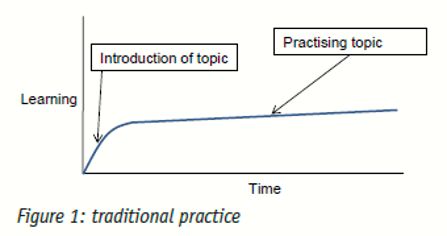
    Traditional practice for a streamed low attaining class might have looked like this: Teach primary content then mindless practice. The diagram in figure 1 shows what happens to the students learning over time, which plateaus out.

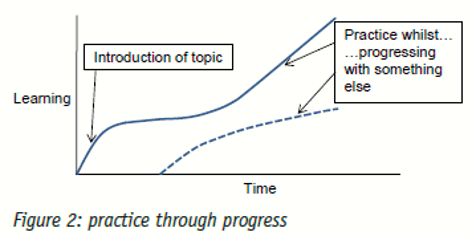
    If we compare this to teaching a class of mixed attainment and where we have to teach to the top students’ knowledge would increase with the introduction and then starts to plateau. However, suddenly they are taught new content making connections with the old, so their knowledge of the subject improves as they begin to practice previous learning within other areas (as seen in the diagram below); this is “Practice through Progress”.

    It is a bold strategy for those who teach within a secondary environment, but our amazing primary colleagues have been teaching mixed attainment for years. So it can be done and can be done well.

    If we want to “shift to curve”, make the gap smaller and empower our disadvantaged learners, bold moves need to happen. Trying the same routine year in and year out and never seeing changes means it is obvious what is happening isn’t working. Be bold for our future generations, be bold for those despondent disadvantaged learners placed in lower sets, be brave, and consider mixed attainment classes.

    Depth and Not Speed

    With all the talk about the “catch up” curriculum, why is it essential to put the brakes on and consider the depth of learning, not speed?

    The pandemic has brought numerous difficulties to the education of our young people, with gaps between the advantaged and disadvantaged widening due to home learning environments and resources of our disadvantaged cohorts.

    Since children in both sectors started to return to the classroom in September 2020, ministers (supported by the press) have been pushing a “catch up” curriculum, talking about extended school days, shorter holidays, additional tuition. Nevertheless, are these the best options for our young people?

    This blog will investigate why we do not need a “catch up” curriculum and how to slow down our teaching.

    Hearing slow down usually worries teachers as they know how extensive their curriculum is and how little time they have to deliver it, and slowing down is the last thing they think they should be doing. However, before dismissing the idea, read on and consider the arguments and the evidence given.

    A correctly sequenced curriculum builds upon previous learning and makes connections. It is not disjointed, so if children have a deep understanding of a topic, they can make sense of scenarios that they have not been taught by applying what they know to a new scenario.

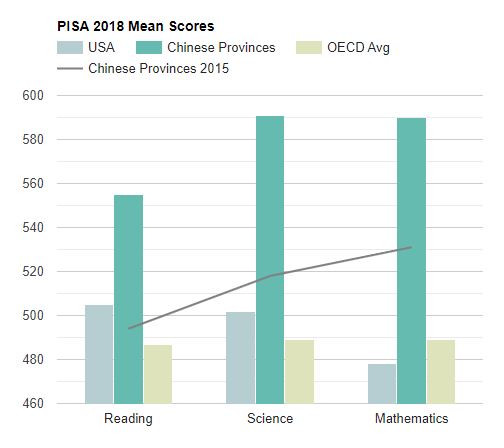
    They do not teach 100% of their curriculum within Oriental countries, but they are consistently top within the PISA rankings. In contrast, they teach almost 100% in America, and their ranking is considerably lower.

    2018 PISA rankings for reading, mathematics and science are below.

    Reading 

    China (Beijing, Shanghai, Jiangsu and Zhejiang) 555 (Only Level 4 country)

    The United States 505 (Level 3)

    The United Kingdom 504 (Level 3)

    Mathematics

    China (Beijing, Shanghai, Jiangsu and Zhejiang) 591 (Level 4)

    Singapore 569 (Level 4)

    China (Macao) 558 (Level 4)

    China (Hong Kong) 531 (Level 4)

    The United Kingdom 502 (Level 3)

    The United States 92 (Level 2)

    Science

    China (Beijing, Shanghai, Jiangsu and Zhejiang) 590 (Only Level 4 country)

    The United Kingdom 505 (Level 3)

    The United States 502 (Level 3)

    PISA Rankings 2018

    However, we can also look towards other countries; Finland is rich in intellectual and educational form. They outrank the United Kingdom in the PISA rankings and are gaining on Eastern Asian countries. So what are they doing? They are not over cramming classrooms and not stressing over exams dictated by the government. They are using common-sense practices. In Finland, the starting age for school is at the age of seven, with only nine years of compulsory education. Compared to the British system, where they start at five, they have 11 years of compulsory education. Making a direct comparison, a child in Finland would start school halfway through key stage 2. There curriculum in Finland centres around making the basics a priority. Not just about the basics of the curriculum, going slower making a more profound connection where cooperation and not competition is the norm but about the students’ wellbeing; since the 1980s, the education system in Finland has made these basics a priority

    1. Education should be an instrument to balance out social inequality.
    2. All students receive free school meals.
    3. Ease of access to health care.
    4. Psychological counselling
    5. Individualised guidance

    So only having nine grades, they must spend longer in school? A typical School day starts at 08:15 and ends at 14:45, with an hour for lunch and 15 minutes between each class. When was the last time students or teachers had an hour for lunch in the UK or time to relax between classes?

    So if it is not the length of the day, then holidays must be shorter? In Finland, they have one week for Autumn break, two weeks for Christmas break, one week for Winter break and around 2.5 months for Summer break. Finland is not a country rushing through the curriculum and underperforming; it is a country of teaching certain things well and prioritising well being, which allows students access into other areas.

    Another country to look towards is New Zealand. In 2011 Christchurch was devastated by an earthquake which led to schools being closed for weeks. Most children in 2011 did not have the technology for online learning or online meetings with their teachers. Professor John Hattie was the advisor to the Qualifications Authority for New Zealand after the earthquake, and he found that results had not dropped; they went up. So why? Teachers looked towards other countries and decided to focus on the learning and not the progress through the curriculum.

    In her book “Mathematical Mindsets”, Jo Bolar has a list of norms, and one of these is “Lessons Are For Learning and Not Progress”. This norm is what the schools in Christchurch did; they focused on learning instead of progressing through the curriculum. 

    “It is not the time in class, but what we do in the time we have that matters.” Professor John Hattie

    The blog about “Using Your Interactive Whiteboard Too Much” is one way I am focusing on learning and not speeding through the curriculum. Having a lesson problem to focus on and thinking deeply about what information the students need to complete this problem has helped with the engagement of disadvantaged students within the classroom. Focusing on what they need to learn to achieve this problem supplies them with the educational content to use it within unfamiliar situations.

    To help our disadvantaged students within this country, we do not need a “Catch-Up” curriculum. What we need is the autonomy to focus on the learning that matters. Making links between what the students already know—taking Jo Bolar’s norms along with the curriculum/school system of the Eastern Asian countries and that of New Zealand and Finland in looking at depth focusing on the learning and not the progress the students are making with the curriculum.

    Are you using your interactive whiteboard too much?

    Consider these two scenarios:

    Scenario one 

    A disadvantaged student walks into a lesson late and misses the explanations of the work as these were on some PowerPoint slides.

    Scenario two

    A disadvantaged student finds writing difficult and struggles to copy work quickly down from a PowerPoint slide, and the notes in the book are patchy and incomplete.

    Both scenarios lead to the student struggling to complete any classwork from that lesson. In Japan and China, they do not have interactive whiteboards within their classrooms but instead have huge blackboard’s. Teachers spend much time thinking about the information that goes onto the board and stays and which information gets erased. In Shanghai, they call this Bansho, which means the art of board work.

    So how can Bansho help disadvantaged students? Researching into Bansho, the use of the interactive whiteboard has decreased during lessons. Bansho has had a positive effect on the teaching and learning of all students but a more significant effect on those from disadvantaged backgrounds. There are two large whiteboards within my teaching room, next to the interactive board; while planning lessons, I am now conscientious of how these boards enhance students’ progress.

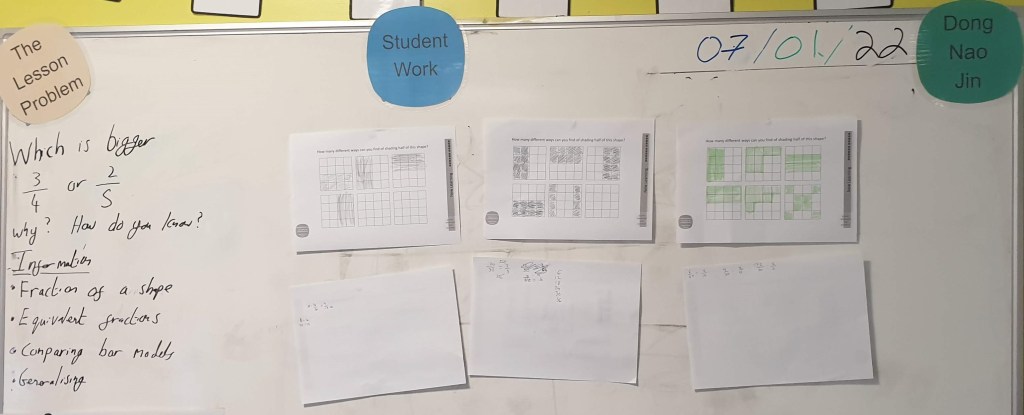
    The first board dedicates space to the “Lesson Problem” and the students work. The “Lesson Problem” forms the title for the lesson and highlights what mathematical skills the students need to solve this, more on this in a later post. The majority of the board shows students thoughts and ideas as they develop the mathematical skills required.

    Board 1

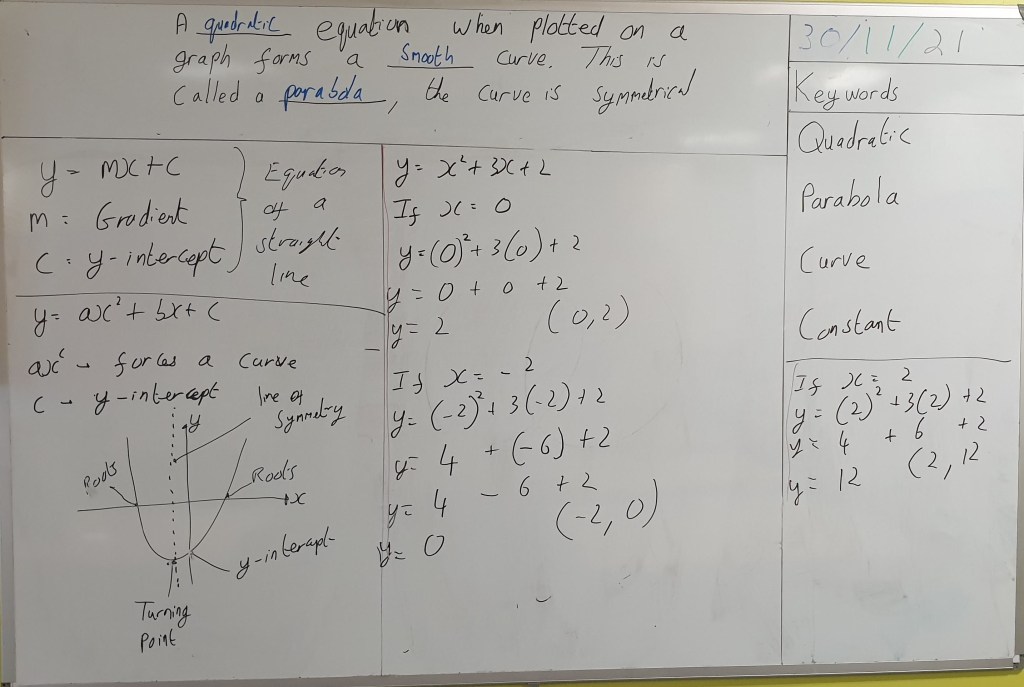
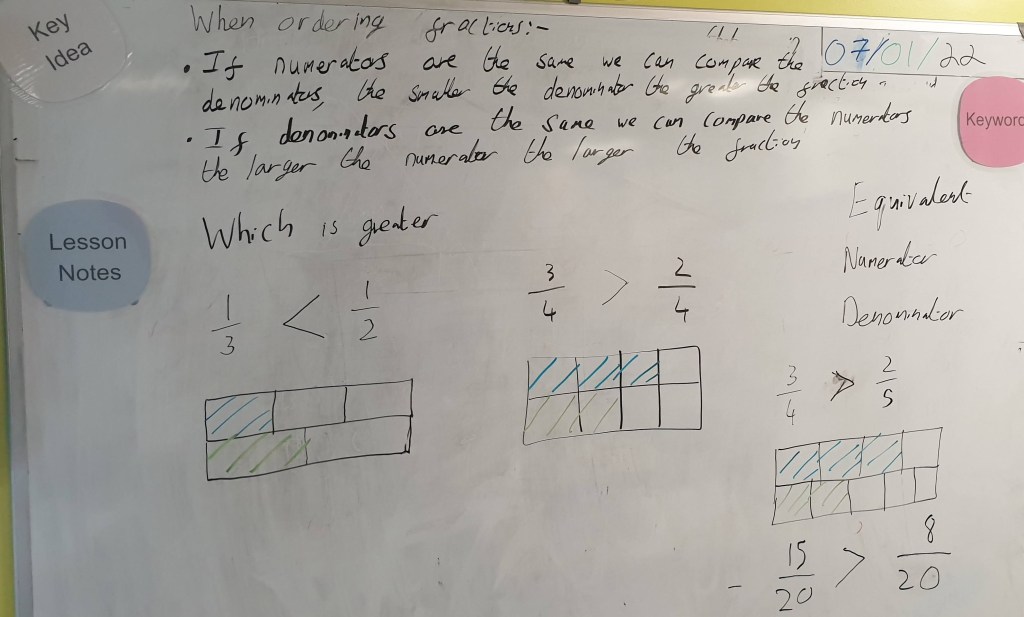
    The second board focuses on work that will not be erased, such as critical ideas, keywords and notes. Work on this board does get erased. 

    Board 2 (Example 1)

    Having a dedicated space to write class notes that stay for the whole lesson means that any student who arrives late or struggles to copy work down quickly has access to the notes of the lesson for the entire duration lesson. Bansho also helps show the students how to write efficient notes even though this is a large whiteboard, carefully thinking about what will be written on this board that is meaningful and help the students to learn.

    Board 2 (Example 2)

    Is this just good teaching? Yes and No. It is about using the board as a tool that will help all students within the room progress and being very deliberate about what information you want them to see consistently and the specific order they see this in. For each lesson, a “Bansho Planning Sheet” is used, which helps to think about what the students work on board one will be and the specific learning points that will enhance the learning. If it is not written down on the sheet, it does not go on the second board.

    It is good practice to take pictures of the board after the lesson to analyse and think was anything missed out? Were the learning points specific? Could the students progress fully with the notes given? With this information, future lessons are then amended and improved.

    Within my practice, this has changed the culture of my classroom; students across all attainments are more focused as they are not being bombarded with information overload; this has led to those more challenging students focusing and enjoying learning, disadvantaged students being able to keep up with the learning, books are neater as they are not rushing to get down notes.