Shifting the curve is dedicated to improving the attainment of young people from disadvantaged backgrounds
You can contact me at
Who am I
My name is Matt Johnson and I am a maths teacher in a school in Bradford which has a very high proportion of disadvantaged students. I have the belief that every child can achieve and there is no such thing as a maths person.
The brain is a wonderful tool that will grow and allow students to achieve their potential.
I am also a Mastery Specialist for the West Yorkshire Maths Hub, an SLE for the Co-op Academy trust and a Pupil Premium reviewer.
Why is it important to shift the curve
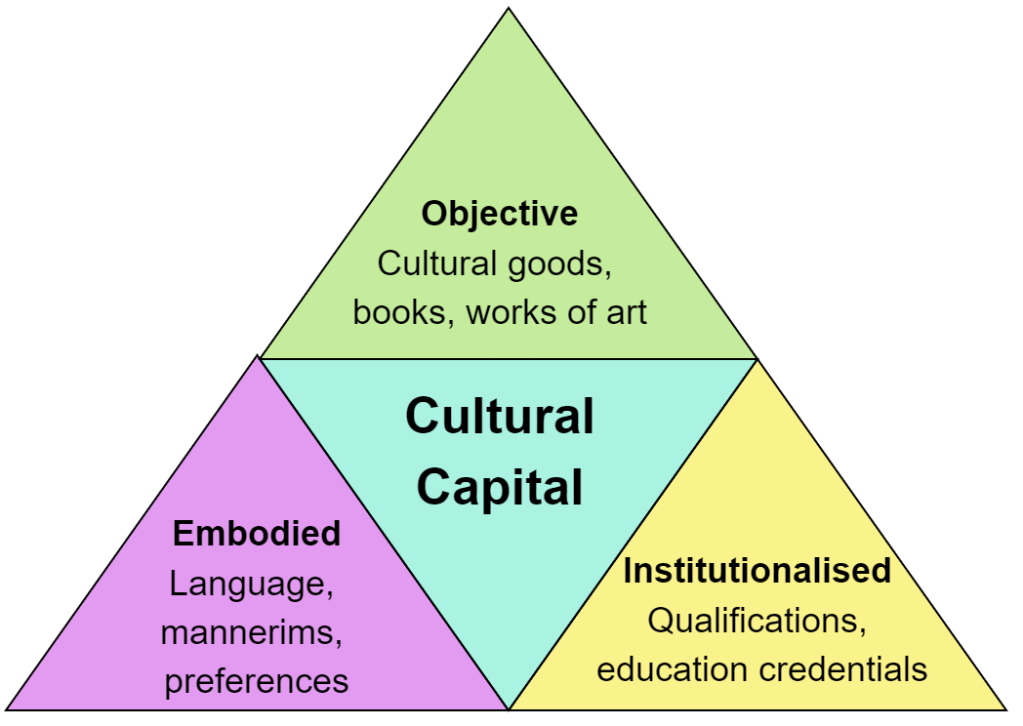
Pierre Bourdieu (French sociologist and public intellectual) believed that cultural capital formed the foundation of social life and dictated one’s position within the social order. He identified three sources of cultural capital
Objective: cultural goods, books, works of art
Embodied: language, mannerisms, preferences
Institutionalised: qualifications, education credentials
Consider these traits as a triangle (seen below), if one of them is missing then the others can’t survive. Qualifications and educational credentials are vital for a child to progress within the world but without any cultural goods or the current language, mannerisms or even a positive mindset the path to gaining these qualifications becomes turbulent and difficult to follow leading to the gap between the advantaged and disadvantaged growing.
It is important to shift the curve so that every child from every background can compete in the global market it is vitally important that all groups of society have an excellent education to provide them with these traits.
My aim is to help provide ideas to you to help advance your teaching toolkit. Such as assessment without grades, why lessons should be about learning and progress, mixed attainment teaching, depth not speed, Bansho boardwork and Dong Nao Jin moments.
- Adaptive Responsive Teaching: The Equity Strategy That Closes the Disadvantage GapFor years, schools have tried to close the disadvantage gap through interventions outside the classroom—revision sessions, mentoring programmes, and targeted catch‑up. While these can help, they often arrive too late. The real battleground for equity is not after school or after the assessment cycle. It is during the lesson itself, in the micro‑decisions teachers makeContinue reading “Adaptive Responsive Teaching: The Equity Strategy That Closes the Disadvantage Gap”
- The Adaptive Responsive Teaching Compass: A Blueprint for Equitable, High‑Impact ClassroomsIntroduction In classrooms where learners bring diverse starting points, needs, and barriers, teaching cannot rely on a fixed script. Learning is rarely linear, and students don’t all follow the same route to understanding. Adaptive Responsive Teaching offers a way to navigate this complexity with precision and purpose. It functions much like a GPS for aContinue reading “The Adaptive Responsive Teaching Compass: A Blueprint for Equitable, High‑Impact Classrooms”
- ⚖️ The Ethical Maths Classroom: High Expectations, Oracy, and EquityIn too many classrooms, mathematics is viewed as a subject of fixed ability—a gatekeeper that sorts students into those who “get it” and those who don’t. This mindset is not only limiting, but it’s fundamentally untrue and unethical. Imagine a maths classroom where every student is treated not as a learner, but as a mathematician.Continue reading “⚖️ The Ethical Maths Classroom: High Expectations, Oracy, and Equity”
 Shiftingthecurve