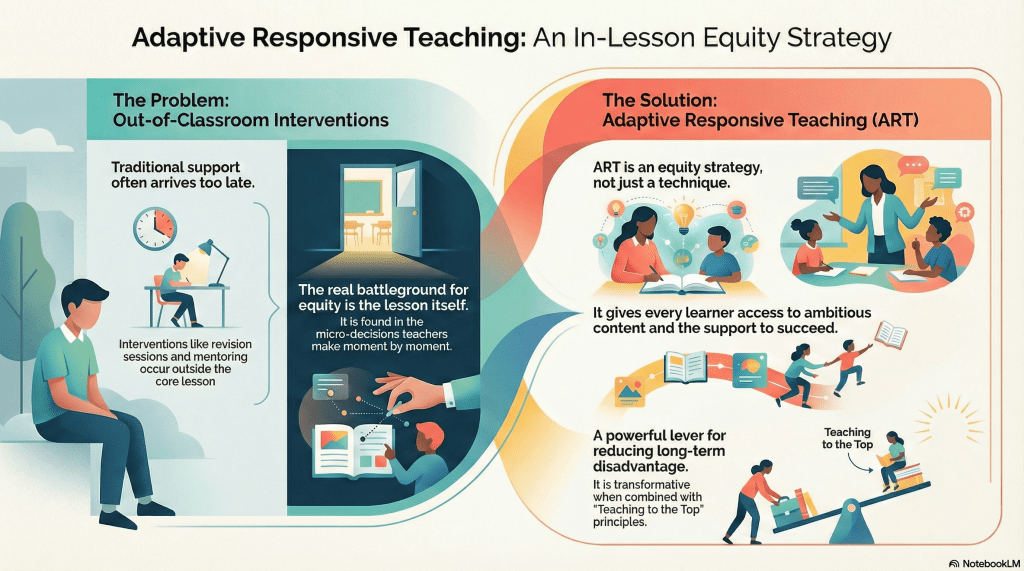
For years, schools have tried to close the disadvantage gap through interventions outside the classroom—revision sessions, mentoring programmes, and targeted catch‑up. While these can help, they often arrive too late. The real battleground for equity is not after school or after the assessment cycle. It is during the lesson itself, in the micro‑decisions teachers make as they respond to what learners do and do not yet understand.
This is where Adaptive Responsive Teaching (ART) becomes transformative. It is not simply a pedagogical technique. It is an equity strategy—one that ensures every learner, regardless of background, is given access to ambitious curriculum content and the support needed to succeed with it.
When combined with the principles of Teaching to the Top, ART becomes one of the most powerful levers schools have for reducing long‑term disadvantage.
Teaching to the Top: The Mindset Behind Real Challenge
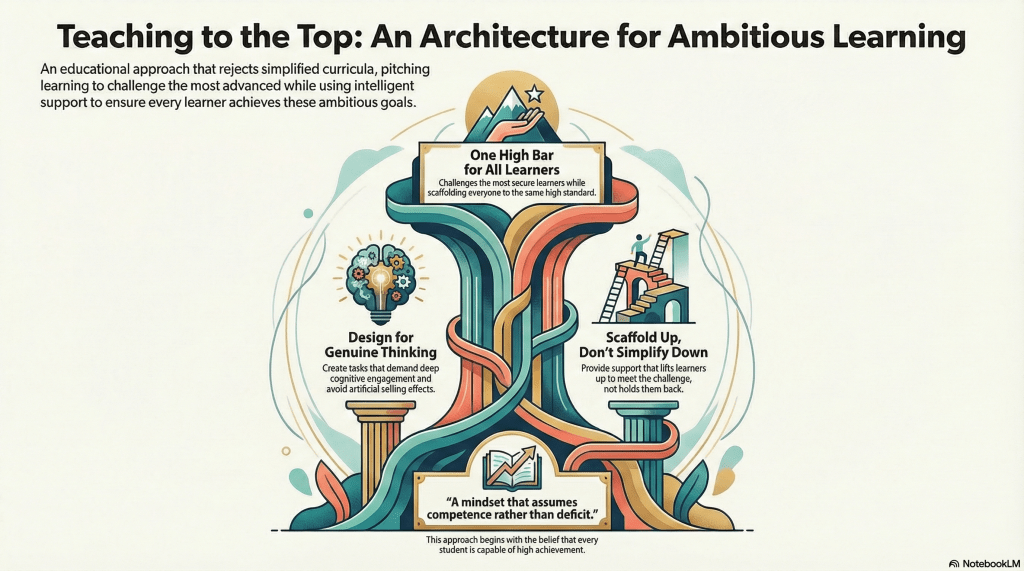
Teaching to the Top is built on a simple but uncompromising belief:
Every learner deserves access to high challenge and powerful knowledge.
This approach rejects the idea that some students need a “lower” version of the curriculum. Instead, it insists that teachers set learning at a level that challenges even the most secure learners, while using intelligent scaffolding to ensure everyone reaches the same destination.
Teaching to the Top is not about making students work harder for the sake of it. It is about:
- Setting ambitious goals
- Designing tasks that require genuine thinking
- Avoiding ceiling effects
- Using scaffolds that lift learners up, not hold them down
It is a mindset that assumes competence rather than deficit. And it aligns perfectly with Adaptive Responsive Teaching.
Adaptive Responsive Teaching: The Method That Makes Ambition Possible
If Teaching to the Top sets the ambition, Adaptive Responsive Teaching provides the mechanism for ensuring all learners reach it.
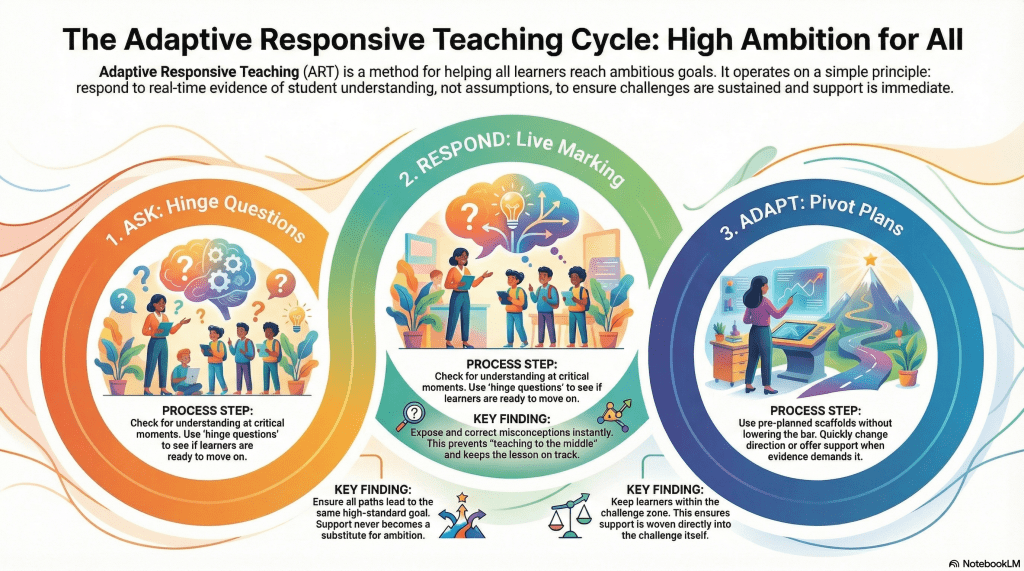
ART is built on a simple principle:
Respond to real‑time evidence, not assumptions.
Instead of waiting until after the lesson to discover who struggled, ART ensures that misconceptions are caught early, support is immediate, and challenge is sustained.
Three practices make this possible:
1. Hinge Questions: Precision in the Moment
Hinge questions are the pulse checks that reveal whether learners are ready to move on. They expose misconceptions at the exact moment they matter most.
In a Teaching to the Top classroom, hinge questions:
- Prevent “teaching to the middle”
- Signal when to deepen the challenge
- Identify who needs scaffolding—not simplification
- Ensure no learner is left behind as the lesson progresses
They turn assessment into a live tool for equity.
2. Live Marking: Feedback That Keeps Challenge Alive
Live marking shifts feedback from retrospective to immediate. Instead of discovering errors after the lesson, teachers address them in the moment.
This matters for equity because:
- Misconceptions are corrected before they become entrenched
- Learners stay within the challenge zone
- Teachers can adjust explanations, models, or scaffolds instantly
Live marking ensures that the challenge is not diluted simply because some learners need more support. Instead, support is woven into the challenge.
3. Pivot Plans: Scaffolding Without Lowering the Bar
Pivot plans are pre‑planned adaptations that allow teachers to change direction quickly when evidence demands it. They ensure that scaffolding is purposeful, temporary, and aligned with the high‑challenge goal.
Pivot plans prevent the common equity pitfall of accidental ceiling‑setting. They guarantee that:
- Every learner works towards the same high‑standard outcome
- Alternative routes still lead to the same destination
- Support never becomes a substitute for ambition
This is Teaching to the Top in action.
What Equity Looks Like in Practice
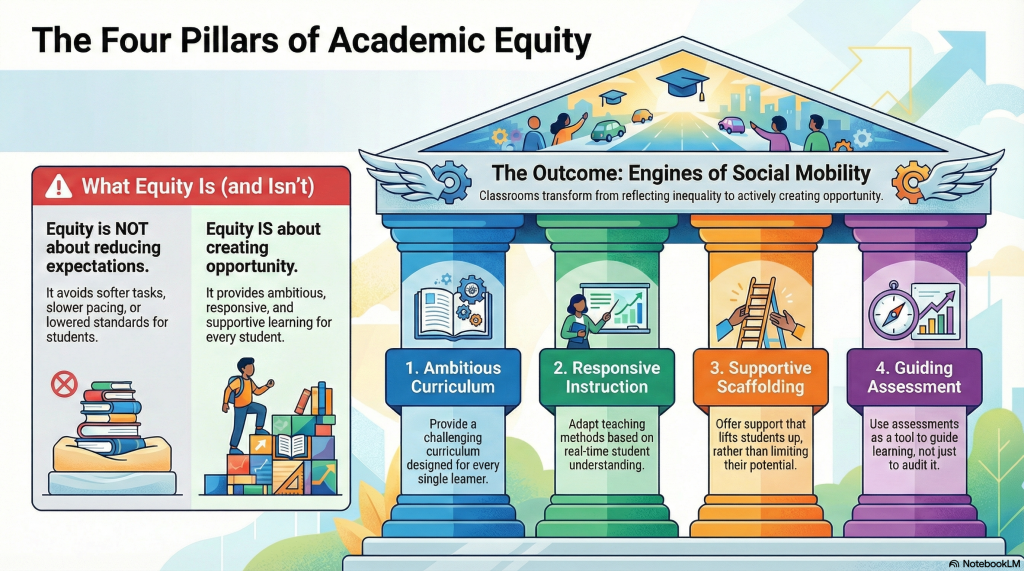
Equity is not about softer tasks, slower pacing, or reduced expectations.
Equity is:
- Ambitious curriculum for every learner
- Responsive instruction that adapts to real‑time understanding
- Scaffolding that lifts, rather than limits
- Assessment that guides learning, not audits it
When Teaching to the Top and ART work together, classrooms become engines of social mobility rather than mirrors of existing inequality.
The Micro-Decisions That Close the Gap
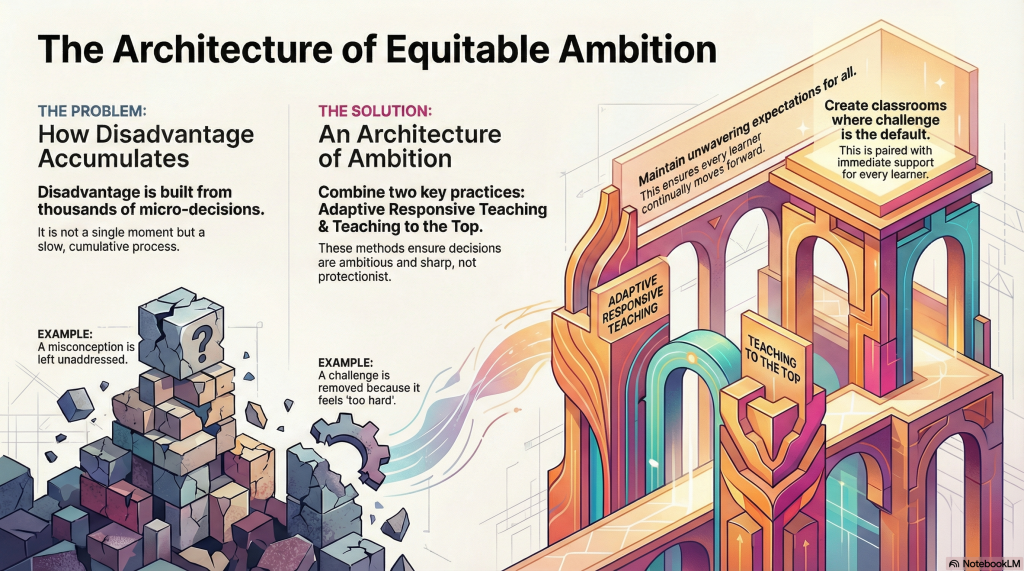
Long‑term disadvantage does not emerge from a single moment. It accumulates through thousands of micro‑decisions:
- A misconception left unaddressed
- A scaffold left in place too long
- A challenge was removed because it felt “too hard”
- A learner quietly opting out of thinking
Adaptive Responsive Teaching sharpens these decisions.
Teaching to the Top ensures they are rooted in ambition, not protectionism.
Together, they create classrooms where:
- Challenge is the default
- Support is immediate
- Expectations are unwavering
- Every learner moves forward
This is what equity looks like when it is lived, not just stated.
Making Every Moment Count
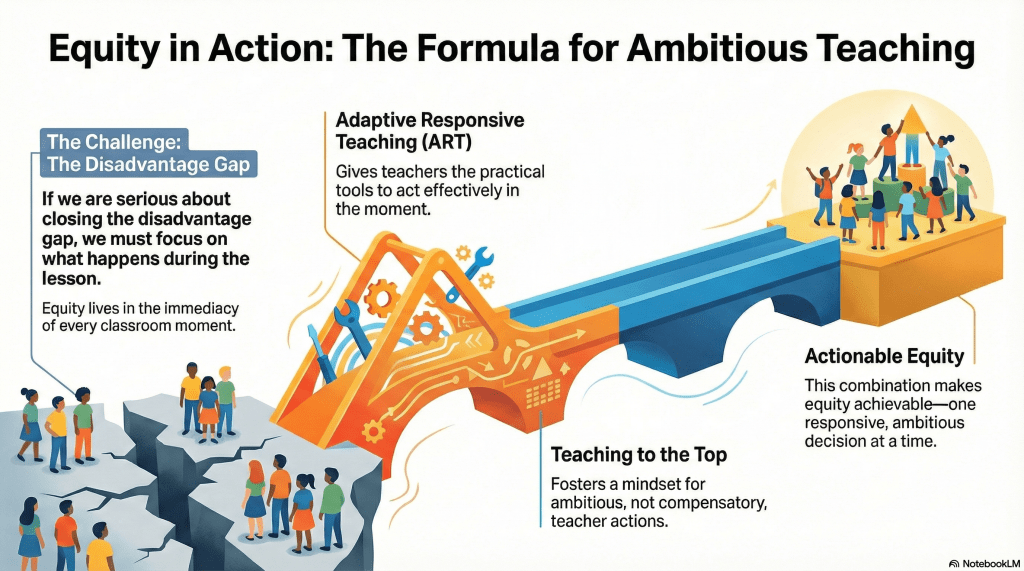
If we are serious about closing the disadvantage gap, we must focus on what happens during the lesson. Adaptive Responsive Teaching gives teachers the tools to act in the moment. Teaching to the Top gives them the mindset to ensure those actions are ambitious, not compensatory.
Equity lives in the immediacy of the classroom.
ART and Teaching to the Top make that equity visible, actionable, and achievable—one responsive, ambitious decision at a time.
 Shiftingthecurve