Introduction
In classrooms where learners bring diverse starting points, needs, and barriers, teaching cannot rely on a fixed script. Learning is rarely linear, and students don’t all follow the same route to understanding. Adaptive Responsive Teaching offers a way to navigate this complexity with precision and purpose.
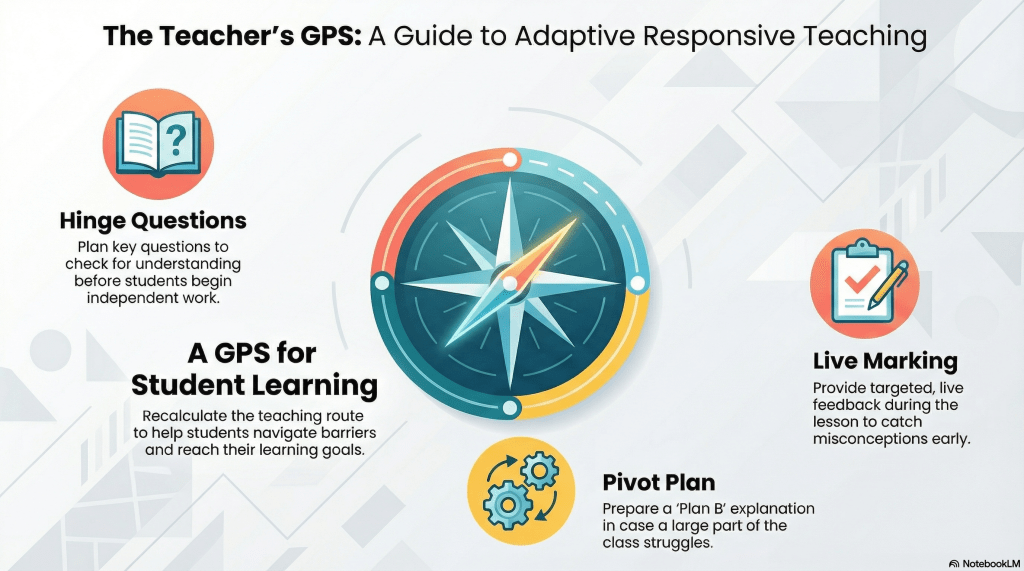
It functions much like a GPS for a student’s learning journey. Rather than following a rigid map, the teacher continually recalculates the route based on the roadblocks a student encounters—particularly SEND‑related barriers. The destination remains the same for everyone: high academic standards. But the path becomes more accessible, more responsive, and more attuned to the learner’s needs. This ensures that every student, regardless of their starting point, can reach the summit through a route that works for them.
This philosophy underpins the entire Adaptive Responsive Teaching model: a system built on real‑time evidence, flexible instructional pivots, and an unwavering commitment to equity.
What Is Adaptive Responsive Teaching?
Adaptive Responsive Teaching is built on the principle that instructional decisions should be shaped by what students actually understand—not what we assume they understand. This aligns strongly with the Education Endowment Foundation (EEF), which emphasises diagnostic assessment, responsive instruction, and high‑quality feedback as core drivers of pupil progress.
Teachers gather real‑time evidence through three core practices:
1. Hinge Questions
Hinge questions reveal whether students have grasped the core concept before moving on. They expose misconceptions and guide the teacher’s next move.
The EEF’s Teacher Feedback guidance states that feedback is most effective when it is timely, specific, and actionable. Hinge questions provide exactly this.
The EEF’s SEND in Mainstream Schools guidance highlights that pupils with SEND benefit from frequent, low‑stakes checks for understanding, which reduce cognitive load and prevent misconceptions from accumulating.
Doug Lemov’s Check for Understanding mirrors this approach, insisting on frequent, high‑quality data to inform instructional decisions.
2. Live Marking
Live marking provides immediate, individualised feedback during the lesson. It prevents misconceptions from becoming entrenched and supports rapid correction.
The EEF emphasises that in‑lesson feedback is often more impactful than written comments delivered later.
Pupils with SEND benefit from immediate, precise feedback, as delayed feedback increases the risk of misconceptions becoming embedded.
This aligns with Lemov’s Show Call and Right is Right, in which student work serves as a live teaching tool and feedback is academically rigorous.
3. Pivot Plans
A Pivot Plan is a pre‑prepared alternative explanation or model that can be deployed instantly if a significant proportion of the class has not grasped a concept.
The EEF’s Implementation guidance stresses the importance of anticipating barriers and planning for likely misconceptions.
The EEF notes that pupils with SEND often require multiple representations, alternative explanations, and structured scaffolds. Pivot Plans ensure these supports are intentionally designed in advance.
This mirrors Lemov’s Double Plan, where teachers plan both teacher actions and student actions in parallel.
How Adaptive Responsive Teaching Drives Equitability
Equitability is not about giving every student the same thing—it’s about giving every student what they need to reach the same high‑standard destination.
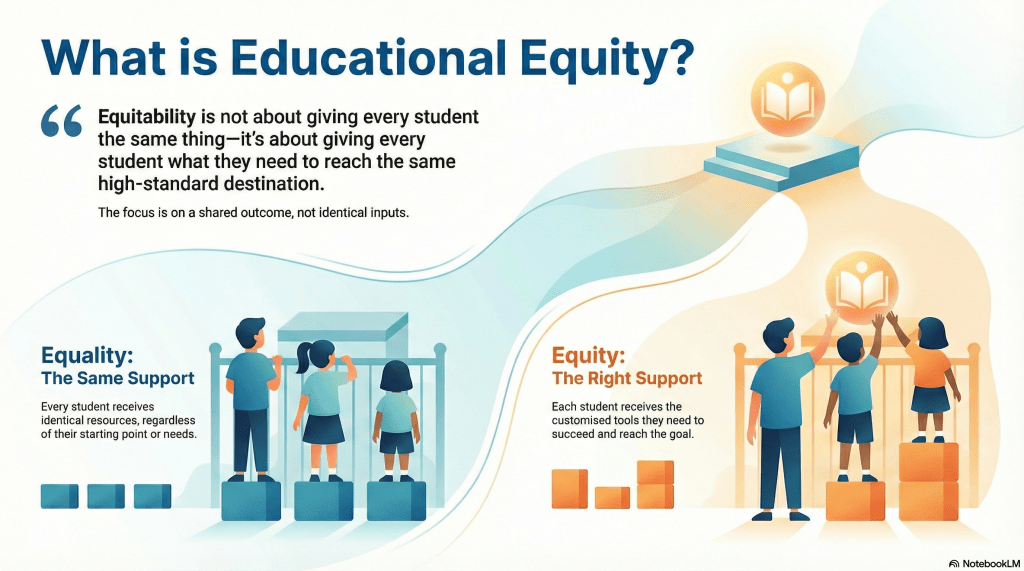
The Adaptive Responsive Teaching Compass supports this across three domains.
1. Equitability in the Classroom
Adaptive Responsive Teaching ensures that no student is left behind during the lesson.
- Live marking enables immediate intervention.
- Pivot Plans ensure the whole class moves forward together.
- Real‑time feedback loops prevent small misunderstandings from becoming long‑term gaps.
The EEF identifies adaptive teaching, scaffolding, and explicit instruction as the most effective strategies for supporting SEND learners. Adaptive Responsive Teaching operationalises all three.
This echoes Lemov’s No Opt Out and Cold Call, ensuring every student participates and receives the support needed to succeed.
2. Equitability in the Curriculum
High expectations remain the anchor point.
SEND barriers are treated as roadblocks, not reasons to lower the destination. The curriculum stays ambitious, but the route becomes flexible.
The EEF stresses that high‑quality teaching is the most important lever for improving outcomes for pupils with SEND. The SEND Code of Practice reinforces that pupils with SEND should access a broad, balanced, ambitious curriculum.
This aligns with Lemov’s Stretch It and Format Matters, which maintain academic rigour while supporting students to reach it.
3. Equitability in Assessment
Formative assessment becomes a proactive tool for success, not a post‑mortem of failure.
- Hinge questions confirm readiness for independent practice.
- Mini‑whiteboard checks provide a whole‑class snapshot within seconds.
The EEF highlights that pupils with SEND often require more frequent, smaller assessment points to prevent overload and ensure misconceptions are caught early.
This aligns with Lemov’s Exit Tickets and Check for Understanding.
A Helpful Analogy: The Mountain Guide

Imagine a teacher as a mountain guide leading a diverse group of hikers. The summit—the high‑standard learning goal—is the same for everyone. But the guide might:
- Offer a walking stick to one hiker
- Suggest a gentler path for another
- Pause to re‑explain a tricky section
The goal isn’t to get some hikers to the top. It’s to get everyone there, together.
Adaptive Responsive Teaching embodies this philosophy.
Why This Matters
Adaptive Responsive Teaching provides a practical, evidence‑driven framework for making equity real. It empowers teachers to:
- Maintain high expectations
- Respond to learning as it happens
- Remove barriers before they become entrenched
- Ensure every student reaches the intended destination
This isn’t just good pedagogy—it’s a moral imperative.
Adaptive Responsive Teaching is the compass that points the way.
Research Links
EEF – Teacher Feedback to Improve Pupil Learninghttps://educationendowmentfoundation.org.uk/education-evidence/guidance-reports/feedback
EEF – Special Educational Needs in Mainstream Schoolshttps://educationendowmentfoundation.org.uk/education-evidence/guidance-reports/send (
EEF – Assessment and Feedback Evidencehttps://educationendowmentfoundation.org.uk/education-evidence/teaching-learning-toolkit/feedback
EEF – Putting Evidence to Work: A School’s Guide to Implementationhttps://educationendowmentfoundation.org.uk/education-evidence/guidance-reports/implementation
Hinge Questions – Jamie Clarkhttps://newsletter.jamieleeclark.com/p/hinge-questions
Formative Assessment – Renshaw & Wiliamhttps://portal.geography.org.uk/downloads/journals/TG_AUT_2015_RENSHAW.pdf
 Shiftingthecurve