The argument I used to change our classes to mixed attainment focused on our department values, “High Expectations for Everyone”. For many years, this has been a value, yet students have been streamed into sets based upon their Key Stage 2 results or new to the country.
“We have high expectations, but we are putting you into this bottom set based on your current attainment”.
Not very motivational is it or a feeling of high expectations.
So how did the change happen?
The pandemic helped this change; in the academic year 2020-22, like many other schools, Co-op Academy Grange school looked different with student bubbles and zones—year seven taught in tutor groups that were mixed attainment. It was amazing to see what was happening at the data collection points throughout the year.
From the first data point of the year, the positive effects of having mixed-ability classes could be seen. The main areas of improvement were the PP cohorts (especially the PP students with no KS2 data). The difference between the highest and lowest entry attainment is narrowing based on year on year data.
The data prompted discussions on the best way forward; some colleagues suggested rolling this on a year at a time; the argument I used centred around :
1) Every Child Can Achieve
2) Saying and acting as having high expectations.
3) Shifting the curve
In September 2021, we went to mixed attainment in our maths department. Year 7-9 full mixed attainment as everyone had the right to be taught the entire key stage 3 national curriculum, and in year 10, we mixed for higher and foundation. With this change, we now have our first Key Stage 4 year group where two classes in each band are studying towards the higher paper.
Recommendation eight of the EEF guidance report on improving mathematics in KS two and three states that
“The research evidence suggests that allocating pupils to maths classes based on their prior attainment (often called ‘setting’ or ‘ability grouping’) does not, on average, lead to an increase in attainment overall and may widen attainment gaps”.
It slightly negatively impacts pupils allocated to lower sets, although pupils allocated to higher sets may benefit slightly. Disadvantaged pupils are more likely to be assigned to lower sets, so the setting is expected to lead to a widening of the attainment gap between disadvantaged pupils and their peers.”
The last sentence is key to all of this where it talks about the widening gap between our disadvantaged and non-disadvantaged students.
The EEF has researched “Setting or Streaming ” and has found that it adds 0 months progress onto a child’s yearly attainment. If it doesn’t develop in year attainment, it is surely pointless to “Set or Stream”, and another approach is needed.
Being afraid to take on a mixed class is a natural feeling. However, learning flourishes the weaker students to “up their game” all students progress but with the disadvantaged students advancing faster, closing the gap.
How often have you said or heard “This class cannot do this” because of the lower teacher expectations. The evidence also points to that streaming students may construct negative self-fulling prophecies for disadvantaged pupils. Their chances of improving attainment and experiencing success are hampered by lower teacher expectations and between class stratification.
Traditional practice for a streamed low attaining class might have looked like this: Teach primary content then mindless practice. The diagram in figure 1 shows what happens to the students learning over time, which plateaus out.
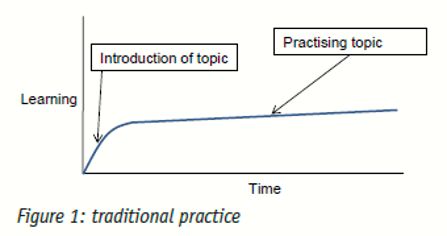
If we compare this to teaching a class of mixed attainment and where we have to teach to the top students’ knowledge would increase with the introduction and then starts to plateau. However, suddenly they are taught new content making connections with the old, so their knowledge of the subject improves as they begin to practice previous learning within other areas (as seen in the diagram below); this is “Practice through Progress”.
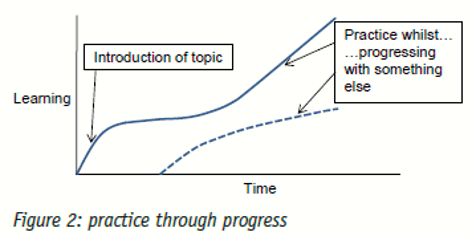
It is a bold strategy for those who teach within a secondary environment, but our amazing primary colleagues have been teaching mixed attainment for years. So it can be done and can be done well.
If we want to “shift to curve”, make the gap smaller and empower our disadvantaged learners, bold moves need to happen. Trying the same routine year in and year out and never seeing changes means it is obvious what is happening isn’t working. Be bold for our future generations, be bold for those despondent disadvantaged learners placed in lower sets, be brave, and consider mixed attainment classes.
 Shiftingthecurve