With all the talk about the “catch up” curriculum, why is it essential to put the brakes on and consider the depth of learning, not speed?
The pandemic has brought numerous difficulties to the education of our young people, with gaps between the advantaged and disadvantaged widening due to home learning environments and resources of our disadvantaged cohorts.
Since children in both sectors started to return to the classroom in September 2020, ministers (supported by the press) have been pushing a “catch up” curriculum, talking about extended school days, shorter holidays, additional tuition. Nevertheless, are these the best options for our young people?
This blog will investigate why we do not need a “catch up” curriculum and how to slow down our teaching.
Hearing slow down usually worries teachers as they know how extensive their curriculum is and how little time they have to deliver it, and slowing down is the last thing they think they should be doing. However, before dismissing the idea, read on and consider the arguments and the evidence given.
A correctly sequenced curriculum builds upon previous learning and makes connections. It is not disjointed, so if children have a deep understanding of a topic, they can make sense of scenarios that they have not been taught by applying what they know to a new scenario.
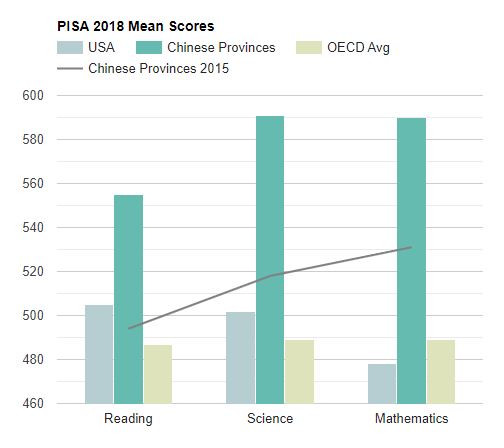
They do not teach 100% of their curriculum within Oriental countries, but they are consistently top within the PISA rankings. In contrast, they teach almost 100% in America, and their ranking is considerably lower.
2018 PISA rankings for reading, mathematics and science are below.
Reading
China (Beijing, Shanghai, Jiangsu and Zhejiang) 555 (Only Level 4 country)
The United States 505 (Level 3)
The United Kingdom 504 (Level 3)
Mathematics
China (Beijing, Shanghai, Jiangsu and Zhejiang) 591 (Level 4)
Singapore 569 (Level 4)
China (Macao) 558 (Level 4)
China (Hong Kong) 531 (Level 4)
The United Kingdom 502 (Level 3)
The United States 92 (Level 2)
Science
China (Beijing, Shanghai, Jiangsu and Zhejiang) 590 (Only Level 4 country)
The United Kingdom 505 (Level 3)
The United States 502 (Level 3)
However, we can also look towards other countries; Finland is rich in intellectual and educational form. They outrank the United Kingdom in the PISA rankings and are gaining on Eastern Asian countries. So what are they doing? They are not over cramming classrooms and not stressing over exams dictated by the government. They are using common-sense practices. In Finland, the starting age for school is at the age of seven, with only nine years of compulsory education. Compared to the British system, where they start at five, they have 11 years of compulsory education. Making a direct comparison, a child in Finland would start school halfway through key stage 2. There curriculum in Finland centres around making the basics a priority. Not just about the basics of the curriculum, going slower making a more profound connection where cooperation and not competition is the norm but about the students’ wellbeing; since the 1980s, the education system in Finland has made these basics a priority
- Education should be an instrument to balance out social inequality.
- All students receive free school meals.
- Ease of access to health care.
- Psychological counselling
- Individualised guidance
So only having nine grades, they must spend longer in school? A typical School day starts at 08:15 and ends at 14:45, with an hour for lunch and 15 minutes between each class. When was the last time students or teachers had an hour for lunch in the UK or time to relax between classes?
So if it is not the length of the day, then holidays must be shorter? In Finland, they have one week for Autumn break, two weeks for Christmas break, one week for Winter break and around 2.5 months for Summer break. Finland is not a country rushing through the curriculum and underperforming; it is a country of teaching certain things well and prioritising well being, which allows students access into other areas.
Another country to look towards is New Zealand. In 2011 Christchurch was devastated by an earthquake which led to schools being closed for weeks. Most children in 2011 did not have the technology for online learning or online meetings with their teachers. Professor John Hattie was the advisor to the Qualifications Authority for New Zealand after the earthquake, and he found that results had not dropped; they went up. So why? Teachers looked towards other countries and decided to focus on the learning and not the progress through the curriculum.
In her book “Mathematical Mindsets”, Jo Bolar has a list of norms, and one of these is “Lessons Are For Learning and Not Progress”. This norm is what the schools in Christchurch did; they focused on learning instead of progressing through the curriculum.
“It is not the time in class, but what we do in the time we have that matters.” Professor John Hattie
The blog about “Using Your Interactive Whiteboard Too Much” is one way I am focusing on learning and not speeding through the curriculum. Having a lesson problem to focus on and thinking deeply about what information the students need to complete this problem has helped with the engagement of disadvantaged students within the classroom. Focusing on what they need to learn to achieve this problem supplies them with the educational content to use it within unfamiliar situations.
To help our disadvantaged students within this country, we do not need a “Catch-Up” curriculum. What we need is the autonomy to focus on the learning that matters. Making links between what the students already know—taking Jo Bolar’s norms along with the curriculum/school system of the Eastern Asian countries and that of New Zealand and Finland in looking at depth focusing on the learning and not the progress the students are making with the curriculum.
 Shiftingthecurve